
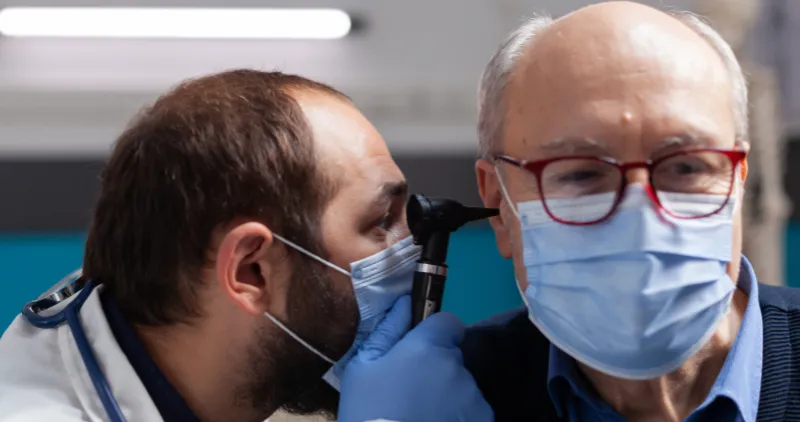
A perforated eardrum can affect hearing, cause repeated discharge and make you worry that the problem may never settle.
Tympanoplasty can repair the damaged eardrum, protect the middle ear and often improve hearing, with published success rates around 90% in many cases.
At Dr. Deenadayal’s ENT Care Centre, Secunderabad, our ENT team provides specialised ear care, including microscopic and endoscopic ear surgery for perforated eardrums and other chronic ear conditions.
Key Takeaways
- Tympanoplasty repairs a hole or damaged area in the eardrum.
- Published success rates are around 90% in many tympanoplasty cases, but individual results vary.
- Tympanoplasty cost in Secunderabad varies according to the procedure, hospital, tests and complexity.
- Basic recovery often takes a few weeks, while hearing may continue improving over several months.
- Keeping the ear dry and following follow-up instructions are important for graft healing.
What is tympanoplasty surgery and what does it repair?
Tympanoplasty is an operation used to repair a perforated or damaged eardrum.
The eardrum is a thin membrane between the ear canal and middle ear. It vibrates when sound enters the ear and helps the hearing system work normally.
When the eardrum has a persistent hole, surgery may involve placing a graft, which is a small piece of tissue used to close the opening.
The aim isn’t only to close the hole. Repairing the eardrum can also help prevent repeated middle-ear infections and discharge.
If the tiny hearing bones behind the eardrum are damaged, additional reconstruction may sometimes be needed during the same operation.
When do you actually need tympanoplasty?
Tympanoplasty is generally considered when an eardrum perforation doesn’t heal on its own or when the ear problem continues to cause symptoms.
Common reasons for considering surgery include:
- A persistent perforation
- Repeated ear discharge or infections
- Conductive hearing loss, meaning sound isn’t travelling properly through the outer or middle ear
- Damage to the eardrum or middle-ear structures
- Certain chronic middle-ear conditions
Not every perforation needs surgery. Some eardrum holes heal naturally, so an ENT specialist first assesses the ear and its healing pattern.
Not sure whether your eardrum needs surgery or will heal on its own? A short ear examination and hearing test can settle it. Book an Appointment with Dr. Deenadayal’s ENT Care Centre, Secunderabad, or Call Now.
Our ear-surgery team also considers whether there is active infection, cholesteatoma or damage to the hearing mechanism before deciding on the procedure.
If foul-smelling discharge is what first brought you in, our guide on why ear discharge smells bad explains how perforations and cholesteatoma can show up that way.
How much does tympanoplasty cost in Secunderabad?
There isn’t one fixed tympanoplasty price because the final cost depends on the patient’s ear condition and the treatment required.
Current publicly published estimates for tympanoplasty in Secunderabad vary from approximately ₹40,000 to ₹1.8 lakh across different providers. Another published estimate places the average Secunderabad range around ₹40,000 to ₹60,000. These figures are market estimates, not a quote from Dr. Deenadayal’s ENT Care Centre.
The final estimate may depend on:
- Type and extent of tympanoplasty
- Surgeon and hospital charges
- Anaesthesia
- Pre-operative hearing and other tests
- Operation theatre and room charges
- Medicines and follow-up
- Whether the tiny middle-ear bones also need repair
A lower or higher estimate doesn’t by itself tell you whether a particular surgery is better. The important question is what treatment your ear actually needs and what is included in the quoted cost.
What is usually included in the cost of tympanoplasty?
The surgery quote may include several separate components, so ask for a clear cost estimate before admission.
Depending on the hospital and package, these may include:
- Surgeon fees
- Anaesthesia charges
- Operation theatre charges
- Hospital or day-care charges
- Diagnostic tests
- Medicines
- Follow-up visits
Published Indian cost guides also identify hospital type, room category, surgical complexity and additional procedures as factors that can change the final bill.
Ask whether the quoted amount includes post-operative visits and medicines, rather than comparing only the headline surgery price.
What happens during tympanoplasty?
During tympanoplasty, the surgeon places tissue over or beneath the perforation so the eardrum can heal and close.
The exact technique depends on the location and size of the hole and the condition of the middle ear.
The graft may be supported with packing while the new eardrum tissue heals. If the small bones responsible for conducting sound are damaged, they may also require repair.
Tympanoplasty can take anywhere from about 30 minutes to several hours depending on the complexity of the case and whether additional work is required.
Is tympanoplasty a major surgery?
Tympanoplasty is a specialised ear operation, but it is commonly performed as a planned procedure rather than an emergency operation.
The complexity depends on what is happening inside the ear.
A simple eardrum repair is different from surgery where there is extensive middle-ear disease, damaged hearing bones or cholesteatoma.
Your ENT specialist can explain the expected extent of surgery after examining the ear and reviewing hearing tests.
What is the success rate of tympanoplasty?
Many tympanoplasty procedures successfully close the eardrum, with published studies reporting success rates around 90% for many cases.
A 2023 meta-analysis of randomised trials found an overall graft success rate of about 90.4% for type I tympanoplasty and found similar closure rates between endoscopic and microscopic approaches.
Indian data points the same way. A retrospective study of 100 chronic ear infection patients at a tertiary centre in Western Maharashtra, available in PubMed Central (NIH), reported graft uptake above 96% at three months with both techniques.
Success isn’t determined by the surgical approach alone.
The size and position of the perforation, condition of the middle ear, previous surgery and other ear problems can influence the outcome.
A published success percentage should therefore be used as a guide, not as a personal guarantee.
Does tympanoplasty always restore hearing?
No, closing the eardrum and restoring hearing are related but not exactly the same outcome.
Some patients experience meaningful hearing improvement after the eardrum heals.
Others may continue to have hearing loss if the middle-ear bones, inner ear or other parts of the hearing system are also affected.
This is why hearing tests before and after surgery are useful. The goal is to understand what part of the hearing pathway is affected before promising how much hearing can return.
How long does tympanoplasty recovery take?
Initial recovery commonly takes a few weeks, but complete healing and hearing improvement can take longer.
Some published hospital guidance describes basic healing over roughly 2 to 4 weeks, while hearing recovery may continue over 8 to 12 weeks or longer, depending on the procedure and individual healing.
You may have some fullness, mild discomfort or altered hearing while the ear heals.
Don’t judge the final hearing result too early. The graft and middle ear need time to settle.
What should you avoid after tympanoplasty?
Protecting the healing ear is one of the most important parts of recovery.
Your ENT surgeon may advise you to:
- Keep the ear dry
- Avoid swimming for several weeks
- Avoid heavy lifting and strenuous exercise initially
- Avoid forceful nose blowing
- Sneeze with your mouth open
- Attend all follow-up appointments
Johns Hopkins advises avoiding strenuous activity and heavy lifting for at least two weeks or longer as directed, and keeping the ear canal dry for several weeks.
Your surgeon’s instructions take priority because recovery restrictions depend on the exact operation performed.
When can you return to work after tympanoplasty?
Many people can return to light daily activities within days to a couple of weeks, but the timing depends on the type of work and the operation.
A desk-based job may allow an earlier return than work involving heavy lifting, dust, physical exertion or frequent travel.
Don’t use the absence of pain as your only guide. The graft can still be healing even when you feel comfortable.
When can you fly after tympanoplasty?
You should wait for your ENT surgeon’s clearance before flying after eardrum repair.
Air travel causes pressure changes, particularly during descent. The timing of safe flying depends on how the repaired eardrum and middle ear are healing.
This is different from an uncomplicated untreated perforation, where flying may generally be safe. After surgery, follow your surgeon’s specific travel advice rather than applying general advice about perforated eardrums.
Can you swim after tympanoplasty?
You should avoid swimming until your ENT surgeon confirms that the ear has healed enough.
Water entering the ear during the healing period can interfere with recovery and increase the risk of infection.
Johns Hopkins advises avoiding swimming for around four to six weeks after tympanoplasty, with the exact timing determined by the treating doctor.
What are the risks of tympanoplasty?
Tympanoplasty is generally considered a safe procedure, but no surgery is completely free of risk.
Possible problems include:
- Infection
- Bleeding
- Graft failure or persistent perforation
- Hearing that doesn’t improve as expected
- Temporary dizziness
- Changes in taste in some cases
- Further ear problems requiring treatment
Cleveland Clinic identifies graft failure as the most common complication and notes that complications overall are uncommon.
The purpose of the pre-operative assessment is to understand these risks in the context of your own ear.
What happens if the tympanoplasty graft doesn’t heal?
If the graft doesn’t heal properly, the eardrum may remain perforated and further treatment may be considered.
A failed graft doesn’t mean the ear can never be repaired.
Your ENT specialist may first determine why the repair didn’t heal and whether infection, Eustachian tube problems, tissue quality or another ear condition is contributing.
Eustachian tube function matters because it controls pressure behind the eardrum, and our guide to ear crackling and Eustachian tube dysfunction explains how that tube works and what happens when it doesn’t open properly.
In selected patients, revision surgery may be considered.
Does an active ear infection affect tympanoplasty?
An active ear infection needs careful assessment before surgery, but current evidence doesn’t support a simple rule that every “wet” ear has a poor surgical outcome.
A 2024 systematic review examined whether active middle-ear infection at the time of tympanoplasty predicts eardrum closure. The authors found mixed results across studies and concluded that stronger evidence is needed before making a firm prediction.
This is why your ENT specialist should assess the ear rather than deciding about surgery based only on whether there is discharge on the day of consultation.
How do doctors assess you before tympanoplasty?
Before recommending surgery, we first determine why the eardrum is damaged and how much of the hearing system is affected.
Assessment may include:
- Examination of the ear with an otoscope or microscope
- Hearing testing
- Review of previous ear infections or surgery
- Assessment of ear discharge
- Evaluation of the middle-ear structures when needed
- Additional imaging in selected complex cases
The treatment plan should be based on the actual condition of the ear, not only on the size of the visible hole.
Can tympanoplasty prevent repeated ear discharge?
Yes, repairing a persistent perforation can help reduce recurrent drainage by restoring the protective barrier of the eardrum.
A perforated eardrum can allow water and bacteria to reach the middle ear more easily.
If discharge is the symptom bothering you most, our ear discharge treatment page explains how the cause is assessed before surgery is considered.
Cleveland Clinic notes that repairing the eardrum can help prevent germs from entering the middle ear and causing infections that lead to drainage.
If there is another cause of chronic discharge, such as cholesteatoma, that condition may also need treatment.
How can you protect the ear after surgery?
The best protection is simple: keep the ear dry, avoid pressure or trauma and follow the exact instructions given by your ENT surgeon.
Don’t insert cotton buds or other objects into the healing ear.
Keep every follow-up appointment even if you feel well. Your surgeon needs to see the graft and confirm healing rather than relying only on symptoms.
When should you contact your ENT after surgery?
Contact your treating team if you develop worsening pain, persistent or increasing discharge, fever, marked dizziness, facial weakness or a noticeable deterioration in hearing.
Some discomfort and temporary hearing changes can occur during healing, but new or worsening symptoms should not be ignored.
Johns Hopkins also lists prolonged dizziness and facial weakness among symptoms that require medical attention after tympanoplasty.
Is tympanoplasty worth considering if hearing loss is affecting daily life?
It may be, especially when a persistent eardrum perforation is causing hearing problems, repeated discharge or infections.
Hearing difficulty can affect conversations, work, school and social situations.
For many patients, the decision isn’t simply about closing a hole. It’s about protecting the ear and improving its long-term function where possible.
Tympanoplasty treatment in Secunderabad
At Dr. Deenadayal’s ENT Care Centre in Secunderabad, our ear-care team evaluates perforated eardrums, chronic ear disease and hearing problems and provides microscopic and endoscopic ear-surgery services when surgery is appropriate.
You can find our ear surgery centre in Secunderabad on Google for directions and timings.
We focus on understanding the cause of the ear problem first, then discussing whether observation, medical treatment or surgery is the right option for that patient.
FAQs
1.Can tympanoplasty be done without general anaesthesia?
The type of anaesthesia depends on the procedure and the patient. Tympanoplasty may be performed under local or general anaesthesia depending on the surgical plan and clinical circumstances.
2.Will tympanoplasty leave a visible scar?
It depends on the surgical approach. Some techniques use the ear canal, while others require an incision behind or around the ear, so the location and visibility of any scar vary.
3.Will my ear feel blocked after tympanoplasty?
Yes, a blocked or full sensation can occur during early healing. Packing placed around the graft can temporarily affect the way the ear feels and hears.
4.Is hearing worse immediately after tympanoplasty?
It can be temporarily reduced after surgery. Packing, swelling and the healing graft can affect hearing during the early recovery period, so the final result is usually assessed later.
5.Can tympanoplasty be repeated if the first surgery fails?
Yes, revision tympanoplasty can be considered in selected patients. The ENT surgeon first looks for the reason the initial repair did not heal before deciding on another operation.
6.Does tympanoplasty treat tinnitus too?
It may improve tinnitus in some patients, but it isn’t a guaranteed tinnitus treatment. The effect depends on why the ringing is present and whether it is related to the middle-ear problem.
7.Can children have tympanoplasty?
Yes, children may undergo tympanoplasty when it is medically appropriate. The decision depends on the child’s age, ear disease, hearing status and likelihood of healing.
8.Can I wear earphones after tympanoplasty?
You should ask your surgeon when it is safe to use earphones. Avoid putting anything into the ear canal until the healing ear has been cleared.
9.Does smoking affect tympanoplasty healing?
Smoking may interfere with tissue healing and is best avoided around surgery. Tell your ENT surgeon if you smoke so they can include this in your surgical advice.
10.Can a perforated eardrum heal without tympanoplasty?
Yes, some perforations heal naturally without surgery. Tympanoplasty is considered when the perforation persists or when the ear has problems such as recurrent discharge or hearing loss.
Final Thoughts
Tympanoplasty can provide a durable repair for a persistent perforated eardrum and may improve hearing, reduce recurrent drainage and protect the middle ear.
Published evidence suggests that many patients achieve successful eardrum closure, often around 90%, but your own result depends on the condition of your ear and the procedure required.
Cost also varies. A proper estimate should be based on your examination, hearing tests, surgical plan and the services included in the hospital quote, rather than a generic online price.
Medical Disclosure
This article is intended for general educational purposes and does not replace an examination or personalised advice from an ENT specialist. Tympanoplasty technique, cost, recovery time, risks and expected hearing improvement vary from patient to patient. If you have a persistent perforated eardrum, recurrent ear discharge, hearing loss or other ear symptoms, consult a qualified ENT specialist for an individual assessment.
Dr. Deenadayal's ENT Care Centre, Secunderabad. Our content team prepares and review by specialist Team.
DECC Clinical Content Team
CALL US FOR ANY HELP
GET IN TOUCH ON