
A sudden sharp ear pain followed by fluid, blood or muffled hearing can be frightening.
A perforated eardrum is often caused by an ear infection, injury or sudden pressure change, and most small tears heal on their own within a few weeks.
At Dr. Deenadayal’s ENT Care Centre in Secunderabad, we focus on finding the cause and protecting the ear while it heals.
Key Takeaways
- Ear infections, injuries, loud sounds and pressure changes can tear the eardrum.
- Most perforated eardrums heal naturally without surgery.
- Keeping the ear dry and avoiding objects inside the ear can support healing.
- Hearing loss, discharge, tinnitus or dizziness may occur after a tear.
- A perforation that doesn’t heal may need a patch or surgical repair.
What is a perforated eardrum?
A perforated eardrum is a hole or tear in the thin membrane separating the ear canal from the middle ear.
The medical name for the eardrum is the tympanic membrane. It vibrates when sound enters the ear and helps transfer those vibrations toward the inner ear.
It also acts as a protective barrier between the outside environment and the middle ear.
When there is a hole, water, bacteria and other material can reach the middle ear more easily, which can increase the risk of infection.
What are the main causes of a perforated eardrum?
The most common causes include middle-ear infection, direct injury, sudden pressure changes and objects entering the ear canal.
Common triggers include:
- Middle-ear infection, when fluid or pus builds up behind the eardrum
- A slap or hard blow to the ear
- Cotton buds or other objects pushed into the ear
- Sudden pressure changes during flying or diving
- Extremely loud sounds or blasts
- Head injuries
- Accidental injury while cleaning or scratching the ear
This is why putting objects inside the ear to remove wax can be risky.
The eardrum is delicate, and you may not realise how far an object has entered the ear canal.
How can an ear infection cause the eardrum to burst?
A middle-ear infection can create pressure behind the eardrum when infected fluid or pus builds up.
If that pressure becomes high enough, the membrane can tear and allow the fluid to drain into the ear canal.
Something interesting can happen at this point.
The severe pain of an ear infection may suddenly improve after the eardrum perforates because the trapped pressure is released.
That improvement doesn’t mean the ear should be ignored.
The infection may still need treatment, and the opening needs time to close safely.
What does a perforated eardrum feel like?
Symptoms can appear suddenly and may include pain, reduced hearing, ringing, discharge or dizziness.
Some people notice:
- Sudden ear pain
- Muffled or reduced hearing
- Clear fluid, pus or blood coming from the ear
- Tinnitus, meaning ringing or buzzing
- A blocked sensation
- Dizziness or a spinning feeling
The exact symptoms depend on what caused the injury and whether other parts of the ear were affected.
Some people may have surprisingly few symptoms and only find out about the perforation during an ear examination.
Can a perforated eardrum heal on its own?
Yes. Most perforated eardrums heal naturally without surgery.
Mayo Clinic states that most ruptured eardrums heal within a few weeks, while the NHS notes that many heal within about two months. Some take longer.
Healing depends on factors such as:
- The size and position of the hole
- The cause of the perforation
- Whether infection is present
- Whether the ear remains protected from water and trauma
- Whether the middle-ear bones or inner ear were also injured
A small, uncomplicated tear has a good chance of closing naturally.
How long does a perforated eardrum take to heal?
Many perforations heal within a few weeks, although some can take up to around two months or longer.
Don’t judge healing only by how your ear feels.
Pain may disappear before the eardrum has completely closed.
Similarly, hearing may remain slightly muffled for some time while the membrane and middle ear recover.
Follow-up examination is the best way to confirm that the hole has actually closed.
What should I do while my eardrum is healing?
The most important step is to keep the affected ear dry and protected.
During healing:
- Keep water out of the ear while bathing
- Avoid swimming until your doctor confirms that it is safe
- Don’t put cotton buds or other objects inside
- Don’t clean deep inside the ear
- Avoid forceful nose blowing
- Use only ear medicines specifically recommended by your doctor
Mayo Clinic and the NHS both recommend protecting the ear from water while the perforation heals.
A healing eardrum needs protection, not repeated cleaning.
Can I put ear drops into a perforated eardrum?
Don’t use ear drops unless an ENT or other qualified healthcare professional has specifically recommended them.
Some medicines aren’t appropriate when there is a hole in the eardrum because they can reach the middle ear.
If an infection is present, your doctor may prescribe a suitable medication.
Avoid using leftover drops from an earlier ear infection without checking first.
The treatment needs to match the condition and the condition of the eardrum.
Can I shower or swim with a perforated eardrum?
You can usually shower if you take care to prevent water from entering the affected ear, but swimming should be avoided until the perforation has healed or your ENT says it is safe.
During bathing, you can protect the outer ear with appropriate waterproof protection recommended by your healthcare professional.
Don’t deliberately rinse the ear canal.
Water entering through the perforation can increase the risk of middle-ear infection.
Can I fly with a perforated eardrum?
A perforated eardrum doesn’t always prevent air travel, but the circumstances matter.
The NHS states that flying can be safe with a perforated eardrum, although this is different from flying soon after surgical repair.
If you have active infection, severe pain, recent trauma or an upcoming ear procedure, discuss travel with your ENT before flying.
If you’re unsure, don’t make the decision based only on whether the ear currently hurts.
How is a perforated eardrum diagnosed?
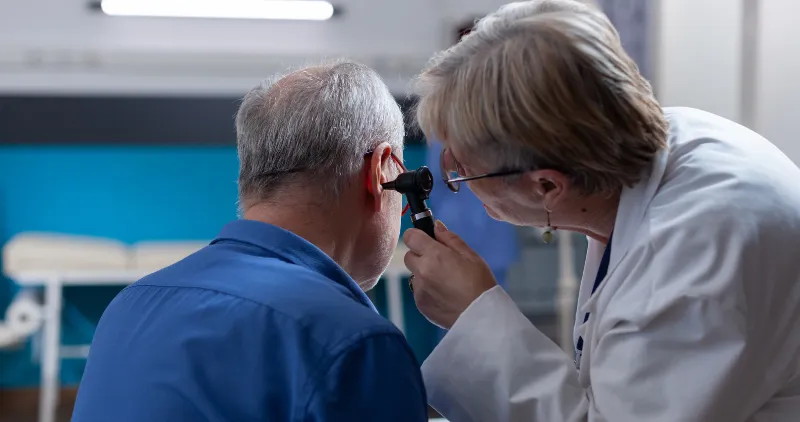
An ENT can usually identify a perforation by examining the eardrum with an otoscope.
An otoscope examination uses a lighted instrument to look through the ear canal and inspect the eardrum.
Your doctor may also recommend audiometry, a hearing test that measures how well you hear different sounds.
A hearing test can help determine whether the hearing loss is mild and temporary or whether another part of the ear may also have been affected.
Why is my hearing still muffled after the pain is gone?
Hearing can remain reduced while the eardrum heals, but persistent hearing loss deserves reassessment.
The tear itself can temporarily interfere with how sound travels.
However, hearing can be affected more substantially if the small middle-ear bones are damaged or if the inner ear has also been injured.
If hearing doesn’t improve as expected, an audiogram can help identify the reason.
This is particularly important after a significant injury or loud-noise exposure.
When does a perforated eardrum need treatment?
Many tears need only observation and careful ear protection, but treatment may be needed if infection is present or the hole doesn’t close.
Depending on the situation, treatment can include:
- Medication for an active infection
- A protective patch over the perforation
- Myringoplasty, a procedure used to close the hole
- Tympanoplasty, surgery to repair the eardrum and, when necessary, associated middle-ear structures
Mayo Clinic notes that a patch may be used when the eardrum doesn’t close naturally, while surgery can be considered when a patch isn’t sufficient.
Surgery isn’t the first step for most uncomplicated perforations. If repair is needed, our ear surgery page explains what to expect before and after eardrum surgery.
What happens if the hole doesn’t heal?
A perforation that remains open can increase the risk of repeated middle-ear infection and ongoing ear discharge. If the discharge has a foul smell, our guide on why ear discharge smells bad explains how perforations and cholesteatoma can show up this way.
Persistent hearing loss can also occur, particularly when other middle-ear structures are involved.
Rarely, a long-standing perforation can be associated with cholesteatoma, an abnormal collection of skin cells and debris in the middle ear that can damage nearby structures.
This is why a perforation that remains open shouldn’t simply be forgotten.
What makes a perforated eardrum less likely to heal?
Ongoing infection, repeated water exposure, continued trauma and damage to deeper ear structures can interfere with recovery.
A perforation may also require more active treatment when it persists despite appropriate observation.
The size and location of the hole can matter too.
If the eardrum hasn’t healed within the expected period, an ENT examination can determine whether continued observation or repair is more appropriate.
When should I see an ENT urgently?
Sudden hearing loss, severe dizziness, significant bleeding, severe pain after an injury or a sharp object entering the ear should be assessed promptly.
You should also seek medical assessment if:
- Fluid or pus continues to drain
- Hearing keeps getting worse
- Dizziness persists
- Symptoms don’t start improving over the following weeks
- A foreign object entered the ear
- The perforation followed significant head trauma
Sudden hearing loss deserves particular attention because it may have causes other than a perforated eardrum and can require urgent treatment.
If you aren’t sure whether the eardrum is perforated, don’t try to check it yourself with a cotton bud or another object.
Can a perforated eardrum be prevented?
Many perforations can be prevented by protecting the ear from injury, unsafe ear cleaning, loud blasts and avoidable pressure-related trauma.
Simple habits help:
- Don’t put cotton buds deep inside the ear
- Keep sharp objects away from the ear canal
- Use hearing protection around extremely loud sounds
- Follow appropriate precautions when diving or flying
- Get persistent ear infections assessed
- Don’t insert unprescribed drops into an ear that may have a perforation
For flying, our guide on how to avoid ear pain during a flight covers ways to prevent airplane ear before it causes injury. The ear is self-cleaning, so deep cleaning isn’t necessary and can sometimes cause injury.
If wax is blocking the ear, professional ear wax removal after an ear examination is safer than cleaning it at home.
The ear is self-cleaning, so deep cleaning isn’t necessary and can sometimes cause injury.
Can hearing return to normal after the eardrum heals?
Yes, hearing often improves when the perforation closes, particularly when the damage was limited to the eardrum.
The final hearing outcome depends on whether the middle-ear bones or inner ear were also affected.
If hearing remains reduced after the eardrum has healed, an audiogram can help identify whether another problem is responsible.
Healing of the membrane and recovery of hearing are related, but they aren’t always exactly the same thing.
What should you remember if you think your eardrum has ruptured?
Don’t panic, but don’t ignore it. Most perforated eardrums heal, and the first priority is protecting the ear while it recovers.
Keep it dry, don’t put objects or unapproved drops inside, and arrange an ENT assessment so the cause and extent of the injury can be confirmed.
At Dr. Deenadayal’s ENT Care Centre in Secunderabad, our ENT and audiology team can examine the ear, assess hearing when required and guide you on whether observation, medical treatment or further repair is appropriate.
If you’re looking for perforated eardrum treatment in Secunderabad, the right approach depends on the cause, size of the tear, hearing status and healing progress. You can find our ear care clinic in East Marredpally, Secunderabad on Google for directions and timings.
Frequently Asked Questions
1.Can a perforated eardrum cause permanent hearing loss?
Usually, hearing loss improves as the eardrum heals, but permanent loss can occur if the middle-ear bones or inner ear were also damaged. A hearing test helps assess the extent of the problem.
2.Can I sleep on the side of a perforated eardrum?
Yes, sleeping on the affected side doesn’t usually prevent the eardrum from healing, but choose the position that is comfortable and avoid putting pressure on a painful ear.
3.Is blood from the ear always a sign of a perforated eardrum?
No. Blood can come from the ear canal or from an injured eardrum, so the source needs to be examined rather than assumed.
4.Can coughing or sneezing make a perforated eardrum worse?
Normal coughing or sneezing usually doesn’t cause a problem, but forceful nose blowing can increase pressure around the middle ear and may interfere with healing.
5.Can I use headphones with a perforated eardrum?
It’s best to ask your ENT before using in-ear headphones while the eardrum is healing, particularly if you have pain, discharge or hearing loss. Avoid inserting anything into the ear canal without medical advice.
6.Can earwax cause a perforated eardrum?
Earwax itself usually doesn’t perforate the eardrum, but trying to remove wax with cotton buds or other objects can injure it.
7.Can a perforated eardrum cause a blocked-ear feeling?
Yes. A tear can cause muffled hearing or a blocked sensation, although these symptoms can also have many other causes.
8.Can children get a perforated eardrum?
Yes. Children can develop a perforation, most commonly in association with middle-ear infection or accidental injury. An ENT assessment is useful because children may not always describe hearing changes clearly.
9.Can a perforated eardrum heal if there is still ear discharge?
It can, but ongoing discharge may indicate infection and should be assessed by an ENT. Keeping the ear dry and treating an infection when present can support recovery.
10.What if my eardrum is still perforated after two months?
An ENT should reassess a perforation that hasn’t closed within the expected healing period. Some persistent holes may need a patch or surgical repair such as tympanoplasty.
Final Thoughts
A perforated eardrum can sound alarming, especially when it happens suddenly. The good news is that most tears heal naturally when the ear is protected and any underlying infection is properly managed.
The most important mistake to avoid is treating the ear as if nothing has happened. Don’t put objects or unapproved drops into the ear, keep water out, and have persistent hearing loss, discharge or dizziness assessed.
With the right care and follow-up, many people recover without surgery.
Medical Disclosure
This article is intended for general health education and doesn’t replace an ENT examination, hearing test or individual medical advice. If you have sudden hearing loss, persistent ear discharge, significant dizziness, severe pain or an ear injury, seek medical assessment promptly.

DECC Clinical Content Team
CALL US FOR ANY HELP
GET IN TOUCH ON