
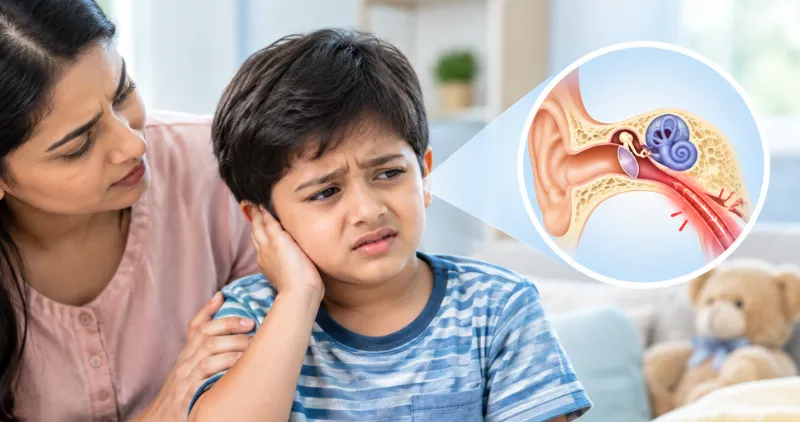
Your child doesn’t always need to say, “My ear feels blocked” for there to be an ear problem. Eustachian tube dysfunction in children can show up as repeated “what?”, turning the TV louder, unclear speech, ear pulling or simply seeming less attentive than usual.
At Dr. Deenadayal’s ENT Care Centre, our pediatric ENT and audiology teams assess children’s ear, hearing and related ENT concerns with age-appropriate evaluation and diagnostic care.
Key Takeaways
- Children can have Eustachian tube problems without obvious ear pain.
- Hearing changes may be the first sign parents notice.
- Colds, allergies, ear infections and enlarged adenoids can contribute.
- Persistent middle-ear fluid can affect hearing, speech and school participation.
- A child’s symptoms, ear examination and hearing tests help guide treatment.
What does the Eustachian tube do in a child?
The Eustachian tube connects the middle ear to the back of the nose and throat, helping balance pressure and drain fluid from the ear. It normally opens when a child swallows, yawns or sneezes.
In young children, these tubes are shorter, narrower and positioned differently from those in adults. This makes it easier for swelling, mucus and infections to interfere with normal drainage and pressure control.
When the tube doesn’t open properly, pressure can build up behind the eardrum.
That can lead to discomfort, popping sounds, reduced hearing or fluid collecting in the middle ear.
What are the signs of Eustachian tube dysfunction in children?
The signs can be subtle, especially in babies and younger children who can’t explain what they’re feeling.
Parents may notice:
- Pulling or rubbing the ear
- Complaining that the ear feels blocked
- Popping or clicking sounds
- Ear discomfort
- Asking people to repeat themselves
- Turning the television or phone volume higher
- Speaking louder than usual
- Not responding when spoken to from another room
- Saying that sounds seem “far away” or unclear
Older children may directly describe ear pressure, muffled hearing, ringing or occasional balance problems.
A child doesn’t need to have severe pain for hearing to be affected.
Why are children more likely to develop this problem?
Children are more vulnerable because their Eustachian tubes are still developing.
A cold can cause swelling around the tube. Allergies can keep the nose and surrounding tissues inflamed. Repeated ear infections can also interfere with normal middle-ear ventilation.
Another important factor is enlarged adenoids.
Adenoids are tissues located behind the nose. When they become enlarged, they can interfere with the opening of the Eustachian tube and contribute to repeated ear problems.
Can a cold cause Eustachian tube problems in a child?
Yes, colds and other respiratory infections are common triggers because swelling and mucus can temporarily block the tube.
A child may recover from the cold but continue to have ear pressure or reduced hearing for some time.
This happens because the middle ear may take longer to return to normal pressure, particularly in younger children.
If your child’s hearing remains reduced after an infection has settled, don’t assume it’s simply part of the cold.
Can allergies and adenoids cause blocked ears?
Yes, ongoing nasal inflammation from allergies and enlarged adenoids can contribute to poor Eustachian tube function.
A child with allergies may have a blocked or runny nose, sneezing and mouth breathing along with ear symptoms.
A child with enlarged adenoids may also snore, breathe through the mouth or have disturbed sleep. Our guide on treating enlarged adenoids without surgery explains the options. When ear problems keep returning, we look at the nose and throat as well as the ear.
When ear problems keep returning, we look at the nose and throat as well as the ear.
Treating only the ear may not address the reason the problem keeps coming back.
Can Eustachian tube problems cause fluid behind the eardrum?
Yes, poor Eustachian tube function can allow fluid to remain in the middle ear, a condition commonly called glue ear or otitis media with effusion.
The fluid isn’t always infected.
A child may have no fever and little or no pain, yet still have reduced hearing because the fluid interferes with normal movement of the eardrum and tiny hearing bones.
This is one reason a child who seems healthy can still have a hearing problem.
Can Eustachian tube dysfunction affect a child’s hearing?
Yes, persistent Eustachian tube problems can cause temporary hearing loss when pressure or fluid interferes with sound transmission.
This type of hearing reduction is often called conductive hearing loss, meaning sound isn’t travelling efficiently through the outer or middle ear.
Parents may not notice the change immediately.
A child may still hear loud sounds but struggle with softer speech, especially in a noisy classroom. Our guide on whether Eustachian tube dysfunction can cause hearing loss explains how pressure and fluid affect hearing.
Can hearing problems affect speech, behaviour or school?
Persistent hearing difficulty can make it harder for a child to follow conversations, develop speech and language skills or participate comfortably in school.
This doesn’t mean every child with middle-ear fluid will develop a speech or learning problem.
The concern is persistent or meaningful hearing reduction, particularly during important stages of language development.
If your child is showing speech delay, unclear speech or difficulty following instructions, hearing should be checked rather than assuming the problem is behavioural.
Why does my child keep asking me to repeat myself?
Repeatedly asking “what?” can be a sign that your child isn’t hearing speech clearly.
Some children compensate by watching your face more closely, moving nearer to the speaker or increasing the volume of the television.
Others may appear distracted or ignore instructions because they didn’t hear them properly.
A hearing assessment can help separate a hearing problem from attention, behaviour or learning concerns. NHS guidance on glue ear also lists asking people to repeat themselves, speaking loudly and increasing TV volume among signs that may indicate hearing difficulty in children.
Does ETD go away on its own in children?
Many temporary cases improve naturally, especially when they follow a cold or short-term nasal inflammation.
That doesn’t mean every child should simply wait indefinitely.
If symptoms are improving, observation may be appropriate.
If hearing problems, ear pressure or recurrent symptoms continue, the child should be assessed to check whether fluid or another condition is keeping the problem going.
When should a child see an ENT for blocked ears?
A child should be assessed when blocked-ear symptoms persist, keep returning or are accompanied by noticeable hearing changes.
An earlier evaluation is appropriate if your child has:
- Sudden hearing reduction
- Significant ear pain
- Fluid or discharge from the ear
- Repeated ear infections
- Balance problems
- Speech or language concerns
- Difficulty hearing at school
- Symptoms affecting sleep or daily activities
Parents don’t need to wait for severe pain before seeking an ENT opinion.
The purpose of the visit is to determine whether the problem is ETD, fluid, infection, wax, hearing loss or another ear condition.
How is Eustachian tube dysfunction diagnosed in children?
Diagnosis usually combines the child’s symptoms with an ear examination and age-appropriate hearing assessment.
Our ENT team may examine the ear canal and eardrum to look for signs of fluid, infection or pressure changes.
Depending on the child’s age and symptoms, testing can include:
- Hearing assessment
- Tympanometry, which checks middle-ear pressure and eardrum movement
- Otoacoustic emissions in appropriate children
- Speech-based or play-based hearing tests
- Assessment of the nose and adenoids when indicated
Pediatric audiology uses different methods depending on the child’s age and ability to respond reliably.
A good evaluation is important because not every child with blocked ears has Eustachian tube dysfunction.
What should parents do if a child has ear pressure after a cold?
For mild symptoms after a cold, parents can usually monitor the child while the infection and nasal swelling settle.
Encourage normal swallowing, drinking fluids and gentle nose blowing.
For older children who can follow instructions, certain pressure-equalising exercises may sometimes be recommended by a clinician.
Don’t forcefully try to pop a young child’s ears, put objects into the ear or use ear drops unless a clinician has advised them.
Does a child always need medicine for Eustachian tube dysfunction?
No, treatment depends on the cause and whether the problem is temporary or persistent.
If the trigger is a cold, observation may be enough.
If allergies are contributing, the child’s doctor may recommend appropriate allergy management. If there is persistent middle-ear fluid, the child may need hearing monitoring and further evaluation rather than repeated courses of medication.
Antibiotics don’t treat fluid in the middle ear unless there is a bacterial infection that requires them.
What happens if middle-ear fluid doesn’t clear?
Persistent fluid with hearing loss may need closer monitoring or treatment, depending on its duration and effect on the child.
Some children improve without intervention.
When hearing remains affected, options can include temporary hearing support or procedures such as grommets, which are small tubes placed in the eardrum to help ventilate the middle ear.
In selected children, treatment of enlarged adenoids may also be considered.
The decision is based on the child’s hearing, symptoms, age, development and examination findings, not simply on the presence of fluid. Our middle ear fluid treatment page explains how persistent fluid is assessed and when grommets are considered.
Can ETD cause speech delay?
Persistent hearing difficulty can contribute to speech and language difficulties, particularly when hearing is reduced during important periods of language development.
This doesn’t mean ETD is the only possible reason for delayed speech.
If a child has speech delay, we recommend looking at hearing as one part of the assessment.
A hearing test can provide useful information even when the child doesn’t complain about the ears.
Are children with repeated ear infections more likely to have ETD?
Yes, repeated middle-ear infections and Eustachian tube problems can be closely related.
When the tube doesn’t ventilate and drain the middle ear properly, fluid can remain behind the eardrum and create an environment where ear problems recur.
A pattern of repeated infections is therefore worth discussing with an ENT.
The aim isn’t only to treat the next infection, but to understand why the child’s ears keep having problems.
What can parents do to reduce future ear problems?
You can’t prevent every episode of ETD, but reducing common triggers can help.
Useful steps include:
- Keep known allergies appropriately managed
- Teach children to blow their nose gently
- Avoid secondhand smoke exposure
- Keep routine vaccinations up to date
- Seek assessment for repeated ear infections
- Pay attention to changes in hearing or speech
Secondhand smoke is associated with a higher risk of middle-ear problems in children.
The most useful prevention step is often noticing a pattern early and getting the right cause assessed.
Can children need surgery for Eustachian tube problems?
Some children with persistent middle-ear fluid and hearing problems may benefit from a procedure, but surgery isn’t automatically needed.
Grommets can help ventilate the middle ear when fluid persists and affects hearing.
Adenoid surgery may be considered in selected children when enlarged adenoids contribute to the problem.
Balloon dilation of the Eustachian tube is different. Current pediatric evidence does not establish it as a routine treatment for children, so decisions must be made carefully by a pediatric ENT based on the individual diagnosis.
What can parents realistically expect after an ENT evaluation?
The first goal is to determine whether your child’s hearing and middle-ear function are actually affected.
Sometimes the answer is reassuring and only observation is needed.
Sometimes we find fluid, repeated infections, nasal allergy, enlarged adenoids or another hearing problem that needs attention.
A clear diagnosis helps parents avoid both unnecessary treatment and unnecessary delay.
When should parents take a child’s hearing concern seriously?
Any consistent change in how a child responds to sound deserves attention, especially if it lasts or affects communication.
Watch for patterns rather than a single incident.
If your child repeatedly turns up the TV, doesn’t respond from another room, asks for repetition, has unclear speech or struggles to follow conversations, don’t assume they’re simply not paying attention.
A hearing assessment can help answer that question.
Where can parents seek Eustachian tube dysfunction treatment in Secunderabad?
At Dr. Deenadayal’s ENT Care Centre in East Marredpally, Secunderabad, our pediatric ENT and audiology services are designed to assess children’s ear, hearing and related ENT concerns.
Our centre provides age-appropriate hearing evaluation, including tympanometry and pediatric audiology approaches when indicated.
You can find our pediatric ENT clinic in East Marredpally, Secunderabad on Google for directions and timings.
If your child has repeated blocked ears, hearing changes, recurrent ear infections or speech concerns, our ENT team can assess the underlying cause and guide the next step.
FAQs
1. Can a child have Eustachian tube problems without ear pain?
Yes, a child can have reduced hearing or middle-ear fluid without significant pain. Changes in listening behaviour may be the main clue.
2. Why does my child complain that sounds are “far away”?
This can happen when sound transmission through the middle ear is reduced, often because of fluid or pressure changes. A hearing assessment can determine whether this is actually happening.
3. Can swimming make Eustachian tube dysfunction worse?
Usually, swimming itself isn’t the main cause of ETD because the problem occurs in the middle ear and Eustachian tube. Ear pain or discharge after swimming may point to a different problem, such as an outer-ear infection.
4. Can ETD cause dizziness in children?
It can sometimes be associated with balance symptoms, but dizziness in a child has many possible causes and shouldn’t automatically be blamed on ETD. Persistent or significant balance problems deserve medical assessment.
5. Can a child outgrow Eustachian tube dysfunction?
Yes, many children experience fewer problems as their Eustachian tubes mature and develop more adult-like anatomy. Persistent hearing or ear problems still need appropriate follow-up.
6. Can earwax look like Eustachian tube dysfunction?
Yes, earwax can also cause muffled hearing or a blocked-ear sensation. An ear examination can usually distinguish wax from a middle-ear problem.
7. Does sleeping with the mouth open mean my child has an ear problem?
Not necessarily, but persistent mouth breathing can occur with nasal blockage or enlarged adenoids, which may also contribute to Eustachian tube problems. An ENT assessment can check both.
8. Can hearing return after fluid behind the eardrum clears?
Yes, hearing often improves when middle-ear fluid clears and normal sound transmission returns. Persistent hearing loss should still be reassessed rather than assumed to be permanent.
9.Can ETD affect only one ear?
Yes, Eustachian tube problems can affect one or both ears. Persistent symptoms on one side should be assessed to identify the cause.
10.Should I wait for my child’s next school hearing screening?
No, you don’t need to wait if you’ve already noticed a hearing or listening problem. Earlier assessment can help identify fluid or another hearing issue that may otherwise be missed.
Final Thoughts
Eustachian tube problems are common in children, and many temporary episodes settle as the underlying cold or inflammation improves.
The part parents shouldn’t ignore is a persistent change in hearing, repeated ear problems, speech concerns or a child who consistently seems unable to hear clearly.
Your child doesn’t have to complain of ear pain for their hearing to need attention.
At Dr. Deenadayal’s ENT Care Centre, East Marredpally, Secunderabad, our pediatric ENT and audiology teams can assess the ears and hearing and help identify whether the problem is related to Eustachian tube function, middle-ear fluid, adenoids or another condition.
Medical Disclosure
This article is for general health education and doesn’t replace a clinical examination or personalised medical advice. Children’s ear and hearing problems can have different causes, and treatment should be based on the child’s symptoms, examination and appropriate hearing tests. Seek prompt medical assessment for sudden hearing loss, severe ear pain, ear discharge, significant dizziness or other rapidly worsening symptoms.
