
That feeling of having your ear blocked, hearing your own voice differently, or hearing a sudden pop when you swallow can be confusing.
Eustachian tube dysfunction happens when the small tube connecting your middle ear to the back of your nose and throat doesn’t open or close normally, affecting pressure, fluid drainage, and hearing.
At Dr. Deenadayal’s ENT Care Centre in Secunderabad, we assess the ear, nose, and throat together because the cause of the ear symptom may actually begin in the nose or sinuses.
Key Takeaways
- Eustachian tube dysfunction can cause ear pressure, fullness, popping, and muffled hearing.
- Colds, allergies, sinus problems, reflux, and pressure changes are common triggers.
- Most short-term cases improve as the underlying swelling settles.
- Persistent symptoms may cause fluid buildup or hearing problems and should be assessed.
- Treatment depends on the cause, not just the blocked-ear feeling.
What is Eustachian tube dysfunction and what does this tube do?
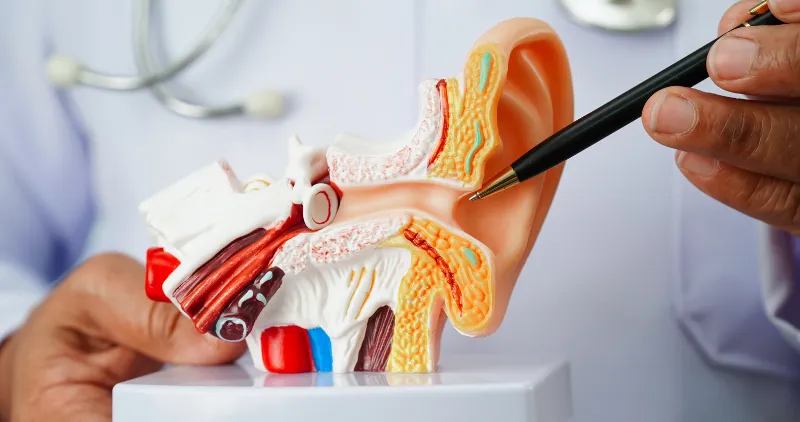
Eustachian tube dysfunction means the Eustachian tube isn’t working normally. Each ear has one Eustachian tube that connects the middle ear to the upper throat and back of the nose.
The tube normally opens briefly when you swallow, yawn, or chew. This allows air to enter the middle ear, balances pressure on both sides of the eardrum, and helps fluid drain away.
When the tube becomes blocked or doesn’t open properly, pressure can build behind the eardrum. This may make the ear feel full, blocked, or as though you’re underwater.
There is also another form called patulous Eustachian tube dysfunction, where the tube stays too open. In this situation, some people hear their own voice or breathing unusually loudly.
Why does Eustachian tube dysfunction happen?
The most common reason is swelling around the Eustachian tube, often related to a cold, allergy, or another nose and sinus problem.
Common triggers include:
- Common cold or flu, which can cause swelling and mucus buildup.
- Allergies, especially when nasal congestion is frequent.
- Sinusitis, which can affect the normal opening of the tube.
- Acid reflux, which may contribute to irritation in the throat and upper airway.
- Flying, diving, or rapid altitude changes, when the ear has to adjust to changing outside pressure.
- Smoking and exposure to cigarette smoke, which can interfere with normal mucus clearance.
- In children, smaller and more horizontal Eustachian tubes make blockage and middle-ear fluid more common.
What does Eustachian tube dysfunction feel like?
The classic feeling is ear pressure or fullness combined with muffled hearing. Some people describe it as having water or cotton inside the ear.
You may also notice:
- Popping or clicking when swallowing
- Ear pain or discomfort
- Ringing in the ear, called tinnitus
- Hearing that seems distant or unclear
- Mild dizziness or balance problems
- Symptoms that become worse during flights or altitude changes
Symptoms that become worse during flights or altitude changes. If popping or crackling when you swallow is your main symptom, our guide on ear crackling when swallowing explains the usual causes.
These symptoms don’t always mean ETD. Earwax, an ear infection, hearing disorders, and other middle-ear problems can produce similar sensations, so persistent symptoms shouldn’t be diagnosed from the feeling alone.
Can Eustachian tube dysfunction affect one ear or both?
Yes, it can affect one ear, both ears, or alternate between the two.
For some people, the problem appears only during a flight or while diving. This pattern is called baro-challenge-induced Eustachian tube dysfunction, where symptoms occur mainly when outside pressure changes.
If pressure or hearing changes remain on one side for a prolonged period, we recommend an ENT assessment rather than repeatedly trying to pop the ear at home. Our guide on muffled hearing in one ear explains when one-sided changes become urgent.
Is Eustachian tube dysfunction serious?
Most short-term cases aren’t serious and improve when the underlying cold, allergy, or inflammation settles. Cleveland Clinic notes that many cases resolve within one to two weeks, although chronic symptoms can last longer.
The concern is persistent dysfunction.
Poor Eustachian tube ventilation can allow fluid to collect behind the eardrum, which may temporarily reduce hearing. Recurrent or prolonged middle-ear problems can require further treatment.
Rarely, chronic dysfunction can contribute to changes in the eardrum or longer-term middle-ear problems. Persistent symptoms deserve attention, but they don’t mean that permanent damage is inevitable.
How is Eustachian tube dysfunction diagnosed?
Diagnosis starts with understanding your symptoms and examining the ear, nose, and throat.
We may ask:
- When the pressure or blockage started
- Whether it followed a cold, allergy, or sinus problem
- Whether symptoms change during flights or travel
- Whether you have hearing loss, tinnitus, pain, or dizziness
- Whether one or both ears are affected
An otoscope examination allows the doctor to look at the ear canal and eardrum. A hearing test checks whether the ear pressure is affecting hearing. Tympanometry measures pressure and movement of the eardrum and can help identify middle-ear fluid or pressure changes.
When nasal or throat problems are suspected, an ENT specialist may also examine the nasal passages and the area around the Eustachian tube.
How is Eustachian tube dysfunction treated?
Treatment depends on why the Eustachian tube isn’t working properly.
If a cold is responsible, the problem may settle as the infection and swelling improve. If allergies are contributing, treatment may focus on controlling the allergy and nasal inflammation, and our nasal allergy treatment page explains how triggers are identified and managed.
For mild symptoms, swallowing, yawning, chewing gum, and appropriate saline nasal care may provide relief. Don’t start antibiotics, steroid medicines, decongestants, or other medication without medical advice, because the right treatment depends on the cause.
Johns Hopkins also notes that some commonly used medicines may not help every type of ETD and can occasionally make symptoms worse.
For persistent obstructive disease, selected patients may need procedures such as ear tube placement, myringotomy to drain middle-ear fluid, or Eustachian tube balloon dilation. These are considered after proper evaluation rather than simply because an ear feels blocked.
What can I do at home to relieve blocked-ear pressure?
For mild pressure related to a cold or temporary congestion, simple actions such as swallowing, yawning, or chewing can help the tube open naturally, as MedlinePlus (U.S. National Library of Medicine) also advises.
During air travel, swallowing frequently and avoiding prolonged nasal congestion may make pressure changes easier to tolerate.
A gentle pressure-equalising technique may help some people, but don’t forcefully blow against a closed nose if it causes pain or if you have another ear condition unless your ENT specialist has advised you to do so.
If the blocked feeling keeps returning, home remedies shouldn’t replace an examination.
When should I see an ENT doctor?
See an ENT specialist when ear pressure, hearing changes, or fullness persist rather than gradually improving.
You should seek assessment sooner if you have:
- Noticeable or sudden hearing loss
- Severe or increasing ear pain
- Persistent dizziness or balance problems
- Repeated ear infections
- Fluid or discharge from the ear
- Symptoms that keep returning without an obvious reason
At this point, the goal isn’t simply to make the ear pop. The goal is to identify what is preventing normal middle-ear ventilation and treat that cause.
Can Eustachian tube dysfunction be prevented?
You can’t prevent every episode, but controlling the conditions that trigger it can reduce recurrence.
This includes managing allergies, treating ongoing nasal or sinus problems, avoiding cigarette smoke, and taking appropriate precautions when flying or diving.
If you repeatedly develop ear pressure after flights, we recommend discussing it with an ENT specialist before your next trip. Repeated pressure-related symptoms may need a different approach from ordinary congestion.
When should I get my blocked ear checked?
A blocked ear after a cold may settle on its own. But if the feeling continues, keeps returning, or is accompanied by hearing loss, pain, discharge, or dizziness, it deserves a proper ear examination.
At Dr. Deenadayal’s ENT Care Centre, our ENT specialists and audiology team assess ear, hearing, nose, and balance symptoms together when needed. Our centre in East Marredpally, Secunderabad, provides ENT evaluation and hearing assessment for patients with persistent ear-related symptoms.
FAQs
1.Can Eustachian tube dysfunction cause a feeling like water is inside my ear?
Yes. Pressure or fluid behind the eardrum can make the ear feel wet, full, or blocked even when there is no water inside the ear canal.
2.Can Eustachian tube dysfunction cause hearing loss?
Yes. It can cause temporary conductive hearing loss when pressure or fluid affects the movement of the eardrum and middle ear. Persistent hearing loss needs a hearing test to identify the actual cause.
3.Can allergies cause Eustachian tube problems?
Yes. Nasal allergy can cause swelling and congestion around the Eustachian tube, making normal pressure equalisation harder. Treating the underlying allergy may reduce repeated symptoms.
4.Why do my ears pop when I swallow?
Your ears may pop because swallowing briefly opens the Eustachian tube and allows pressure to equalise. Occasional popping is normal, but frequent popping with pain or hearing changes should be assessed.
5.Can Eustachian tube dysfunction cause tinnitus?
Yes. Changes in middle-ear pressure can be associated with ringing or other unusual sounds in the ear. Persistent tinnitus should be evaluated because it can have several causes.
6.Can Eustachian tube dysfunction cause dizziness?
Yes, some people with ETD report dizziness or balance problems, although dizziness can also come from inner-ear and other conditions. Persistent or severe dizziness needs proper evaluation.
7.Is Eustachian tube dysfunction common in children?
Yes. Children are more prone to Eustachian tube problems because their tubes are smaller and positioned differently from those in adults. This can make fluid buildup and middle-ear infections more likely.
8.Can smoking make Eustachian tube dysfunction worse?
Yes. Smoke exposure can interfere with normal mucus clearance and increase irritation in the airways, which may contribute to ear and Eustachian tube problems.
9.Can I fly with Eustachian tube dysfunction?
Sometimes, but active pressure-related symptoms can become worse during take-off and landing. If you frequently experience severe ear pain or hearing changes while flying, speak with an ENT specialist before travelling.
10.Can Eustachian tube dysfunction come back after it improves?
Yes. It can recur if the underlying trigger, such as allergies, sinus problems, or repeated pressure changes, continues. Managing that trigger is an important part of preventing repeated episodes.
Final Thoughts
Eustachian tube dysfunction often begins with a simple problem such as a cold, allergy, or pressure change, and many cases settle without major treatment. The important point is not to ignore symptoms that persist or repeatedly return.
When ear pressure, muffled hearing, popping, or balance symptoms continue, a proper ENT examination can determine whether the Eustachian tube is actually responsible and whether the middle ear has been affected.
Medical Disclosure
This article is for general health information and does not replace an examination by an ENT specialist. Ear pressure and hearing changes can have several causes, so diagnosis and treatment should be based on your symptoms, examination findings, and appropriate hearing or middle-ear tests.
