
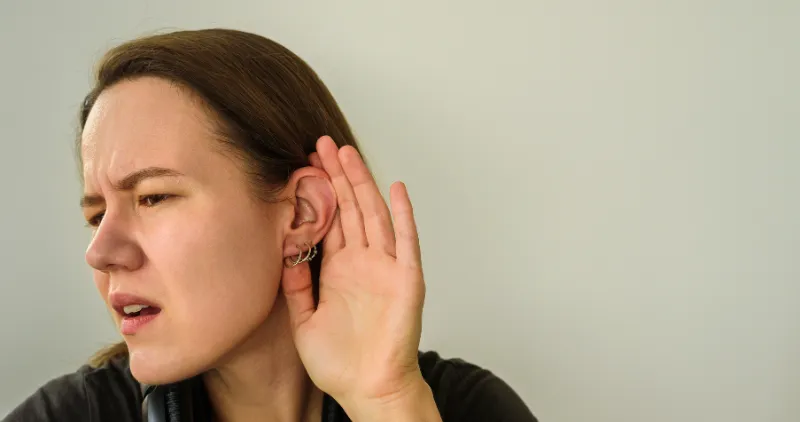
Hearing suddenly sounds muffled, your ear feels blocked, and you may start worrying that your hearing is being permanently damaged.
The good news is that Eustachian tube dysfunction can cause temporary hearing changes, and the hearing often improves when the underlying problem is treated.
At Dr. Deenadayal’s ENT Care Centre in Secunderabad, our ENT specialists evaluate ear pressure, hearing changes, tinnitus and middle-ear problems to identify the actual cause rather than assuming every blocked-ear sensation is ETD.
Key Takeaways
- Eustachian tube dysfunction can cause muffled or reduced hearing.
- The hearing change is usually related to middle-ear pressure or fluid.
- ETD-related hearing difficulty is often temporary, but persistent problems need assessment.
- A hearing test and tympanometry can help identify the type and cause of hearing loss.
- Sudden hearing loss should never be assumed to be simple ear blockage.
What exactly is Eustachian tube dysfunction?
Eustachian tube dysfunction happens when the small tubes connecting the middle ear to the back of the nose and throat don’t open or close normally.
These tubes help keep air pressure balanced on both sides of the eardrum. They also help drain fluid from the middle ear and protect the ear from unwanted secretions and sounds.
When the tube becomes blocked or doesn’t work properly, pressure can build up or become lower than normal inside the middle ear.
That pressure change can make the eardrum move less freely, which may make sounds seem dull, distant or muffled.
Many patients describe it as feeling like they’re hearing underwater or as though cotton has been placed inside the ear.
Can Eustachian tube dysfunction actually cause hearing loss?
Yes, it can cause reduced hearing, most often because of a problem in the middle ear rather than damage to the hearing nerve.
When the Eustachian tube isn’t working properly, the pressure around the eardrum can change. Fluid can also collect behind the eardrum.
Both situations can interfere with the normal movement of the eardrum and middle-ear bones.
This type of hearing problem is generally described as conductive hearing loss, meaning sound isn’t being transmitted normally through the outer or middle ear to the inner ear. Eustachian tube dysfunction is a recognised cause of this type of hearing difficulty.
This is why ETD-related hearing loss can improve when the middle-ear problem settles.
Why does my hearing become muffled when my ear feels blocked?
Muffled hearing happens because the middle ear needs the right air pressure and free movement of the eardrum to transmit sound properly.
Imagine the eardrum as a thin surface that needs to vibrate when sound reaches it.
If pressure changes or fluid collects behind it, that movement can become less effective.
You may notice:
- Sounds seem quieter or unclear.
- Your own voice may sound different.
- One ear may feel more blocked than the other.
- Speech may become harder to understand in noisy places.
- Your hearing may change when you swallow, yawn or change altitude.
These symptoms commonly occur alongside ear fullness, popping, clicking, tinnitus or mild ear discomfort.
What causes the Eustachian tube to stop working properly?
Colds, allergies and nasal inflammation are common triggers because swelling around the Eustachian tube can interfere with its normal opening.
Other possible triggers or contributing factors include:
- Sinus and nasal problems
- Flu or other respiratory infections
- Changes in air pressure during flights or diving
- Exposure to smoke and other irritants
- Enlarged adenoids, particularly in children
- Acid reflux in some patients
The exact cause matters because treating only the ear pressure may not solve the problem if the underlying nasal or inflammatory condition continues.
How serious can ETD-related hearing loss become?
Most short-term cases aren’t dangerous and improve as the underlying inflammation or blockage settles.
Some people have symptoms for days or a few weeks, particularly after a cold or allergy flare.
Persistent Eustachian tube dysfunction is different and shouldn’t simply be ignored. Ongoing middle-ear pressure problems or fluid can affect hearing and, in some cases, contribute to problems involving the eardrum or middle ear.
This doesn’t mean that every patient with ETD will develop permanent hearing damage.
It means that hearing changes that don’t settle deserve an examination so we can confirm what is actually happening.
How do we know if hearing loss is really caused by ETD?
We don’t diagnose ETD from the feeling of a blocked ear alone. We look at the ear and, when needed, measure hearing and middle-ear function.
During an ENT assessment, we may examine:
- The ear canal and eardrum
- The nose and back of the throat
- Signs of fluid or pressure behind the eardrum
- Hearing levels in each ear
- Middle-ear pressure and eardrum movement
A hearing test, or pure-tone audiometry, measures how softly you can hear different sounds.
Tympanometry is another useful test. It checks how the eardrum and middle ear respond to changes in air pressure and can provide evidence of middle-ear pressure problems or fluid. Both tests are available through our audiology services in Secunderabad.
Can ETD-related hearing loss be confused with other hearing problems?
Yes, and this is one reason we shouldn’t assume that every blocked or muffled ear is caused by ETD.
Earwax, middle-ear infection, eardrum problems and inner-ear hearing disorders can produce overlapping symptoms.
A recent ENT review also highlights that ear fullness and hearing loss are not specific to ETD and can occur with several other ear, neurological and structural conditions. Clinical examination and objective testing help separate them.
Sudden hearing loss deserves particular attention.
If hearing suddenly drops, especially in one ear over a short period, don’t simply treat it as congestion or blocked ears. Sudden sensorineural hearing loss is different from the temporary muffled sensation associated with ETD and requires prompt medical assessment. Our guide on muffled hearing in one ear explains how to tell a gradual, congestion-related change from a sudden one.
Can ETD cause hearing loss in only one ear?
Yes, Eustachian tube dysfunction can affect one ear more than the other.
You may notice that one ear feels blocked while the other feels completely normal.
However, one-sided hearing loss should be assessed if it is persistent, unexplained or sudden, because several other conditions can cause hearing changes in one ear.
The pattern of symptoms, ear examination and hearing test help us understand whether ETD is the likely cause.
Can the hearing return to normal after ETD improves?
Yes, hearing can return to normal when the hearing change is caused by temporary middle-ear pressure problems or fluid associated with ETD.
For pressure-related Eustachian tube blockage, MedlinePlus (U.S. National Library of Medicine) says the associated hearing loss is almost always temporary.
The timeline depends on why the tube isn’t functioning properly and how long the middle-ear problem has been present.
For example, ETD associated with a cold may improve as the infection and nasal swelling settle.
If hearing remains reduced after the pressure problem should have resolved, we recommend checking the ear and hearing rather than continuing to wait.
What is the treatment for Eustachian tube dysfunction?
Treatment depends on what is causing the Eustachian tube problem, how long it has been present and whether there is hearing loss or middle-ear fluid.
For mild, short-term cases, observation may be enough because symptoms can settle without specific treatment.
Depending on the cause, treatment may involve managing:
- Nasal allergies
- Nasal inflammation
- Sinus or respiratory problems
- Infection when present
- Other contributing conditions
Some patients may be advised to swallow frequently, yawn or chew gum to encourage the tube to open.
If a clinician recommends pressure-equalising techniques, they should be performed gently. Forceful attempts to pop the ears can cause pain or injury.
For persistent or severe cases, an ENT specialist may consider procedures such as myringotomy, ear tube placement or Eustachian tube balloon dilation in carefully selected patients.
How long does hearing loss from ETD usually last?
There isn’t one fixed recovery time because ETD can have different causes.
When it follows a cold or temporary nasal inflammation, symptoms may improve as the underlying problem resolves.
Some people, however, develop persistent or recurrent ETD and may continue to experience pressure, popping or hearing changes for much longer.
If your hearing isn’t returning to normal, don’t keep assuming that the ear is simply blocked.
A hearing test can tell us whether hearing has actually reduced and whether the problem appears to be in the outer ear, middle ear or inner ear.
What can I do at home when my ears feel blocked?
Simple measures may help mild ETD, particularly when the problem is related to temporary pressure changes.
You can try:
- Swallowing regularly
- Yawning
- Chewing gum
- Staying hydrated
- Using saline nasal spray when appropriate
- Following your doctor’s treatment for allergies or nasal inflammation
Some people are advised to gently equalise ear pressure using an appropriate technique. Don’t blow forcefully against a tightly closed nose and mouth.
If symptoms are severe, keep returning, or continue for weeks, it’s better to have the ear examined rather than repeatedly trying to pop it.
When should I see an ENT doctor for ETD?
You should arrange an ENT assessment when ear pressure, muffled hearing or other symptoms persist, keep returning or interfere with everyday communication.
We’d also recommend prompt assessment if you have:
- Sudden hearing loss
- Severe or worsening ear pain
- Persistent one-sided hearing reduction
- Hearing loss with significant dizziness
- Ear discharge
- Symptoms following significant trauma or pressure injury
Sudden hearing loss should not be assumed to be ETD or earwax because early assessment can be important when the inner ear is involved.
Can ETD affect everyday life and emotional wellbeing?
Yes, even temporary hearing changes can be frustrating and unsettling.
When one ear feels blocked, conversations may become harder to follow, especially in crowded places.
Some people also become anxious because they don’t know whether the hearing change will disappear.
The important thing is to identify the cause rather than constantly worrying about the worst possibility.
Once we know whether the problem is pressure, fluid, infection, earwax or another hearing condition, the next step becomes much clearer.
Can Eustachian tube dysfunction be prevented from coming back?
ETD cannot always be prevented, but controlling the conditions that trigger it can reduce repeated episodes.
If allergies are contributing, keeping them controlled may help.
Avoiding smoke exposure and taking sensible precautions during flights or other rapid altitude changes may also reduce pressure-related symptoms.
If ETD keeps returning, we should look for the reason rather than repeatedly treating the blocked-ear sensation alone.
That may involve assessing the nose, sinuses, allergies, reflux or other factors that could be affecting Eustachian tube function.
Where can I get Eustachian tube dysfunction treatment in Secunderabad?
At Dr. Deenadayal’s ENT Care Centre, our ENT team evaluates hearing loss, ear pressure, tinnitus and middle-ear conditions using clinical examination and hearing assessment when required. Our ENT and hearing centre in East Marredpally, Secunderabad, offers dedicated hearing and ENT care.
If your ear has remained blocked or your hearing has changed, an ENT assessment can help determine whether ETD is actually responsible and whether further treatment is needed.
FAQs
1.Can ETD cause ringing in the ears?
Yes, ETD can cause tinnitus, which means hearing ringing, buzzing or other sounds without an external source. Tinnitus can also have other causes, so persistent symptoms should be assessed. If the ringing affects only one ear or began suddenly, our guide on sudden tinnitus in one ear explains the possible causes.
2.Can you have ETD without an ear infection?
Yes, ETD can occur without an ear infection. Allergies, colds, nasal inflammation and pressure changes can affect Eustachian tube function even when there is no infection.
3.Can ETD make my own voice sound strange?
Yes, ETD can change the way your own voice sounds, particularly in certain types of Eustachian tube dysfunction. This symptom is called autophony and can have several causes.
4.Can flying make Eustachian tube dysfunction worse?
Yes, rapid changes in air pressure during take-off and landing can worsen ETD symptoms. Swallowing, yawning and chewing can help the Eustachian tubes open during these pressure changes.
5.Can children get hearing loss from ETD?
Yes, children commonly experience Eustachian tube problems, and middle-ear fluid associated with poor tube function can affect hearing. Persistent hearing difficulty in a child should be evaluated because hearing is important for speech and learning.
6.Can ETD cause dizziness?
Yes, some people with ETD report dizziness or balance symptoms. However, significant or persistent dizziness can have other causes, so it shouldn’t automatically be blamed on ETD.
7.Can allergies keep causing ETD?
Yes, nasal and allergic inflammation can contribute to repeated Eustachian tube problems. Managing the underlying allergy may therefore be part of controlling recurrent symptoms.
8.Does ETD always need antibiotics?
No, antibiotics aren’t routinely needed for ETD itself. They may be considered when a bacterial infection is actually present, while treatment for allergy or inflammation may be more appropriate in other cases.
9.Can ETD come back after treatment?
Yes, ETD can return if the underlying trigger remains or another episode of inflammation develops. Repeated episodes are a reason to look for contributing nasal, allergic or other problems.
10.Can ear drops cure Eustachian tube dysfunction?
Usually not, because the Eustachian tube is located behind the eardrum and is not treated by ordinary ear drops. Ear drops may be useful for certain outer-ear conditions, but the treatment depends on the actual diagnosis.
Final Thoughts
Eustachian tube dysfunction can cause muffled or reduced hearing, but this doesn’t automatically mean that your hearing is permanently damaged.
In many cases, the hearing change is linked to temporary middle-ear pressure problems or fluid and improves as the underlying condition settles.
If hearing loss persists, keeps returning or appears suddenly, it’s important to have the ear and hearing properly assessed rather than assuming it is just a blocked Eustachian tube.
At Dr. Deenadayal’s ENT Care Centre, Secunderabad, our ENT specialists and audiology team can assess ear symptoms, hearing and middle-ear function and guide you toward the appropriate treatment based on the cause.
Medical Disclosure
This article is for general educational purposes and isn’t a substitute for an individual medical examination or diagnosis. Hearing loss can have many causes, and sudden or unexplained hearing changes should be assessed promptly by an ENT specialist.
